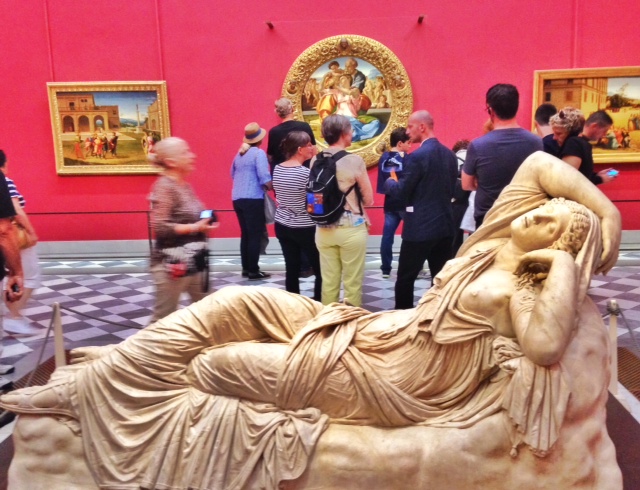
Looking how I was feeling after my class in the Uffuzi Gallery Michelangelo room.
How does a modern day Florentine find his or her own identity in the shadows of so many geniuses? I asked my teacher Benedetta. “Yes, it is hard,” she replied. “I have heard of artists who come here to Florence and never work again, completely crippled by the grandeur of all those masters.”
Today, my teacher, very sweet and humble, said, “Today you will discover my secret. My father is the director of the Uffizi.” She introduced me (swoon) to a handsome man in his early 60s without a trace of pretense. He proudly showed me photos of his three beautiful daughters and wife and I’m thinking, “Um, yes, nice, but can we talk about those stacks of books on your desk? Tell me about your work? What does the director of the Uffuzi do? Can I see the ‘Birth of Venus’ without the glass? Touch it? Let’s get a photo.” But no, I had respect. I simply shook his hand and said, “So nice to meet you,” then did my best not to flood sweet Benedetta with questions about his work.
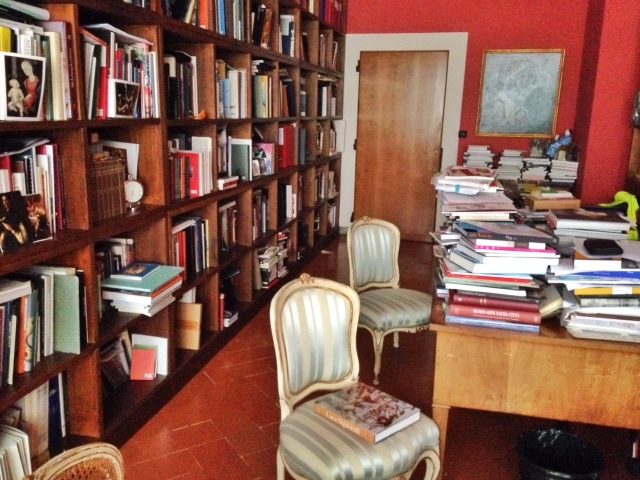
I had to sneak this photo of the director’s office. Look at all of these books! My nightstand at home looks like a mini version of his desk. (Swoon)
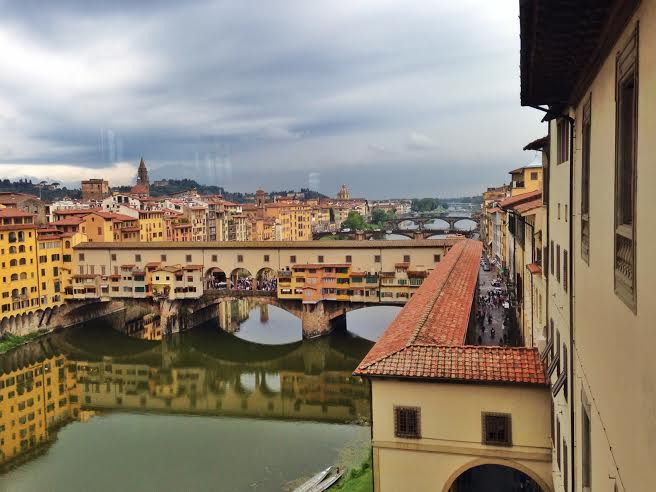
The Vasari corridor as seen from the Uffizi.
Soon, that was not hard, as she is a brilliant and interesting art historian in her own right; her father must be proud. She walked me through Florence in the form of paintings from the 14th to the 17th centuries. I watched the works unfold before the Renaissance, with the strong gold leaf backgrounds and flat figures, to the time when slowly the details emerged. The bodies became 3D, the faces gained expression, the backgrounds became landscapes and the Renaissance exploded in all its full-blown glory.
We walked right through Leonardo, Michelangelo and Raphael’s High Renaissance until we ended with Caravaggio and the Baroque period, with its exaggerated expression and extreme lights and darks.
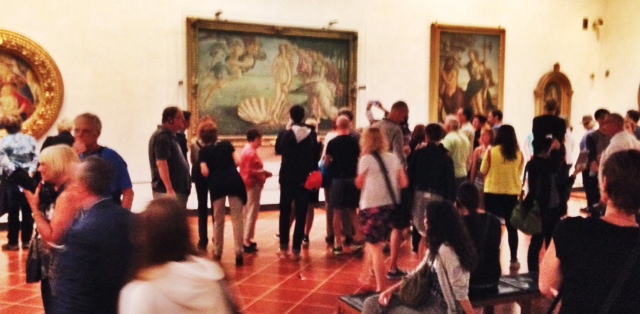
Turns out I’m not the only one completely enchanted by Botticelli.
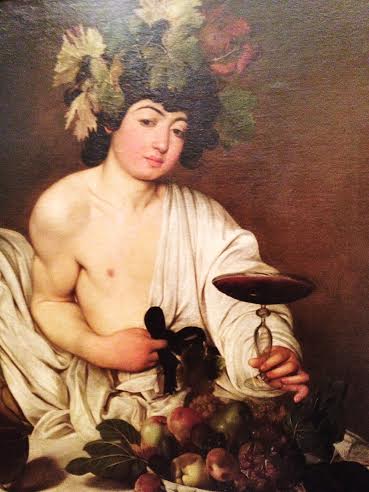
Caravaggio’s “Bacchus”: Gotta love a country that honors the God of Wine. I’ve always loved this painting.
I learned about many of the things that influenced these movements. For example, Michelangelo was in Rome when they uncovered many statues from the Hellenistic period. He was deeply influenced by the extreme gesture and emotion of these works. His own work becoming more filled with expression at this time.
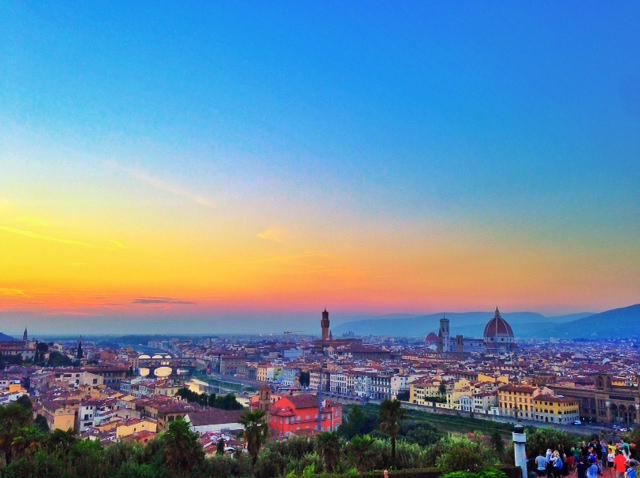
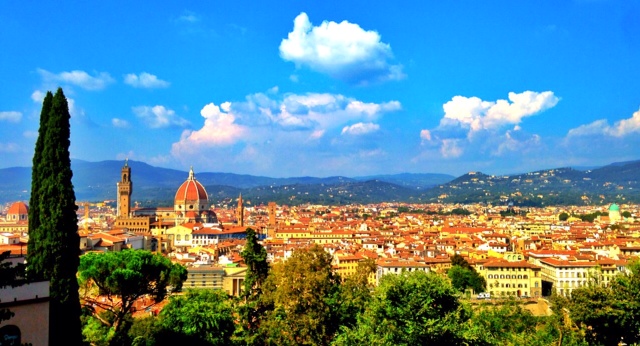
Benedetta and I took a small break on the lovely rooftop cafe with a view of the Duomo as we were finishing up. The legs tire and the mind can hardly comprehend. It’s all almost too much, too much beauty all in one place, too much excitement. One needs to pause to take it in, but then you’re staring at the Duomo, and again you must catch your breath.
This is what I mean when I say you must somehow find your place and keep these geniuses of art off their well-deserved pedestals. You can get psyched out. It might be easy to feel very small, but you must find your own place in the folds of history — maybe not as a famous person but as one of value, as we all are.
I think it must be a certain kind of pressure for Florentine artists, and indeed Benedetta pointed out that in Mannerism, which followed the Renaissance, there was this anxiety for artists to try to paint after this huge and brilliant time where art absolutely blossomed and flourished under the skill of so many huge talents.
I guess you just do as the famous Contemporary artist Chuck Close says: “Show up and get to work.” Yes, I think I will just continue to show up and see what else this city will reveal to me!
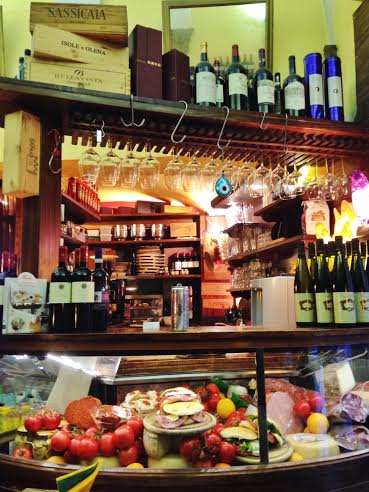
And let us not forget the culinary arts!


 Stephanie Schlatter Art